Showing posts with label Brief. Show all posts

Ancillary Task Research - Website Home Page

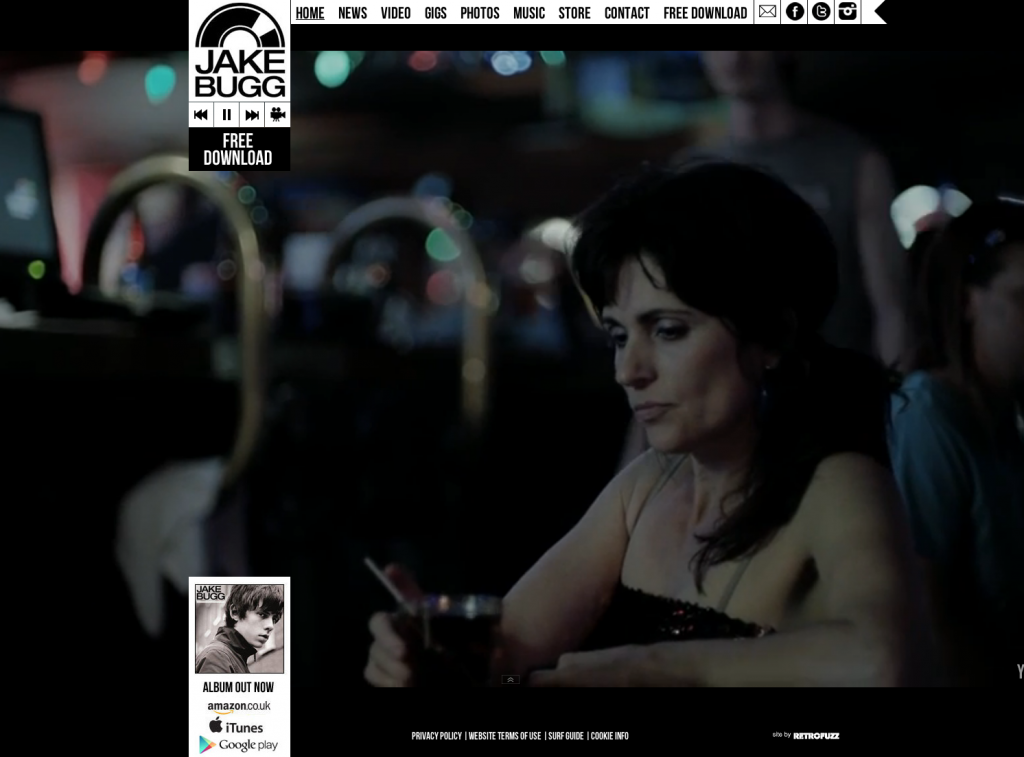
Concurrent with my Digipak research, I am carrying out research into Artist websites so that I can create a website conventional to these. After a little research, however, I wasn't incredibly impressed with a great number of the designs so I am also carrying out research into other websites to take inspiration from and form ideas to merge with the band's website. A feature I really liked, however, from Jake Bugg's website is the rolling video background which includes all of his music videos and some promotional films. This means the user can navigate his site while experiencing his content, creating an incredibly effective promotional site. I will most probably be using the HTML5 code here for this feature:

www.JakeBugg.com
As there isn't much content on the first page, though, I plan to merge this idea with the current structure of the Spotify website where images and backgrounds scroll and differing speeds which heightens interactivity and makes information transfer more efficient:


After some further research, I found that the effect seen above is known as the Parallax Scrolling effect and can be achieved a number of different ways. As this is definitely my favoured idea, I have looked into certain source code and tutorials for creation; one of which, I found at www.GitHub.com and offers all of the code needed for including videos, backgrounds, sprites and text which covers everything I would need. This idea allows for a great deal of band promotion as images feature very heavily. I can take a number of photographs on our shoots to satisfy this. 

Another artist site that I think looks appealing is Tom Milsom's. The main feature that makes similar web pages lose appeal seems to be the over saturation of tour dates and the lack of organisation with these. Milsom's page isn't like this, but Like Bugg's has little content so any inspiration taken would have to be combined with others. The photography is very nice, however, so I can draw from this:
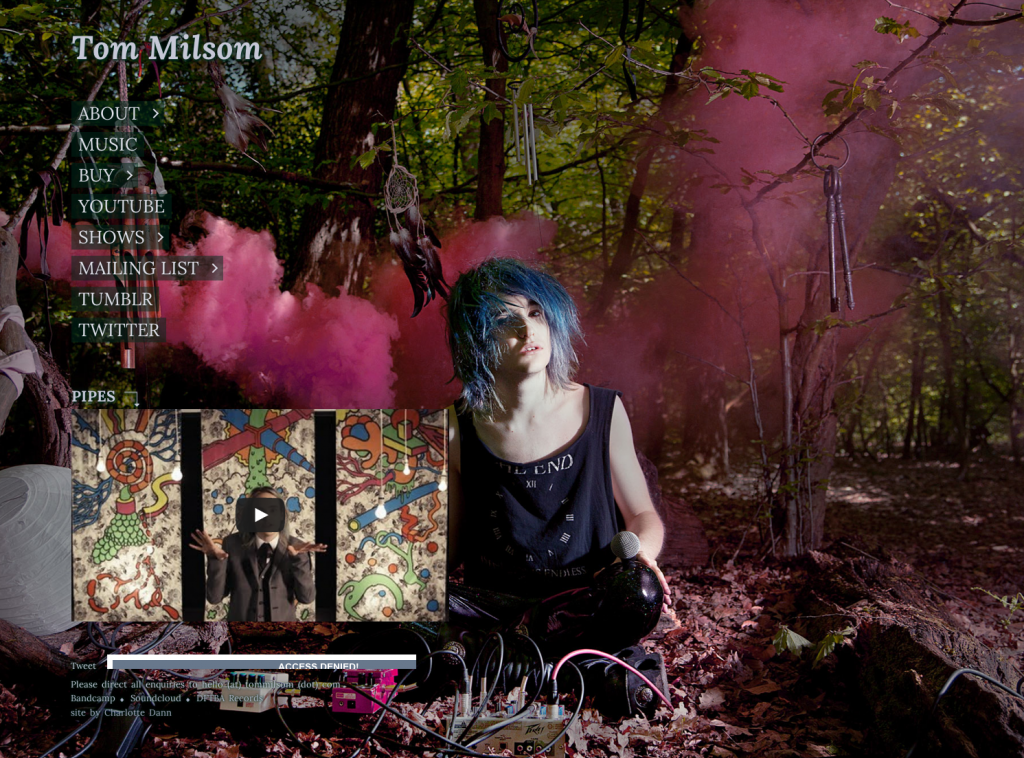
www.TomMilsom.com


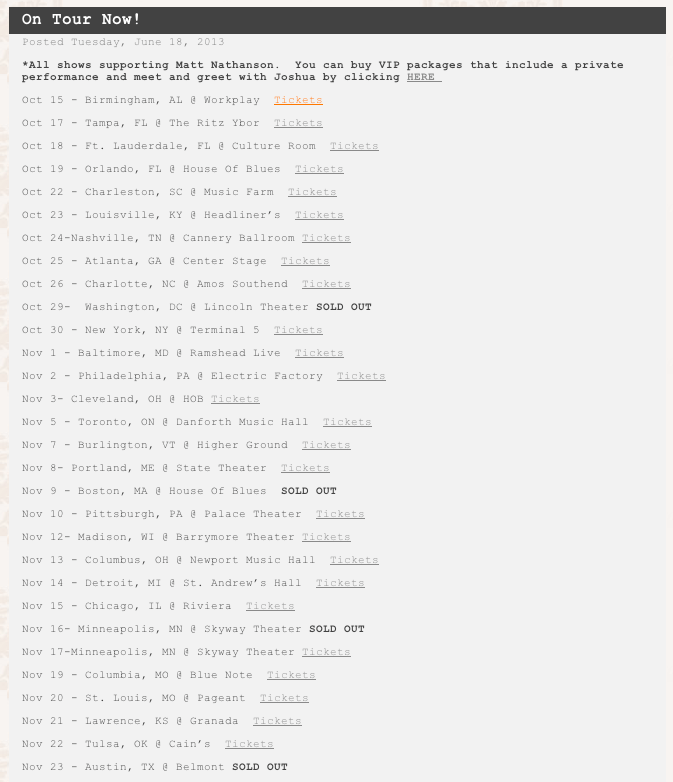
The example to the left is of Joshua Radin's site, which overuses dates and is of a blog style. I want to avoid both of these to produce a smart, original site. The dates make the site very bloated and clunky which is unattractive. The blog form is also very unoriginal and so wouldn't be impressive at all.

In addition, I want to create a raw theme by including elements such as ripped paper backgrounds to lay titles over which I would create myself as quality stock photos of this are rare:


Ancillary Task Research - Digipak

As part of my end project, I am to create an accompanying Digipak and Webpage as ancillary tasks. The first I shall be working on is the Digipak, though before designing a concept for my own, I would like to look into preexisting Digipaks to replicate the conventions and to create a successful design that looks professional and legitimate. Below, therefore, I will be including a number of album artworks and Digipaks with analysis:


  • The thematic design shows that digipaks must be a cohesive product where the designs of each face follow through the end result. 
  • The printing on the disk is similar to an image on another face which increases the cohesion.
  • Minimalist design with a nicely framed, simple image of the artist, accompanied by typography.
  • Information on the inside cover

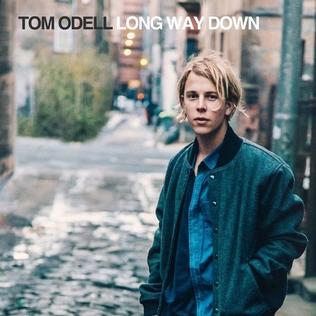
I really like the Tom Odell - Long Way Down album as it's simple and incorporates the widely used, but little perfected white on a light photograph, while still visible. The image is the entire album cover, however, which would be illfitted for the project due to the lack of skill showcasing. The depth of field is particularly effective with the focus purely on the model which looks very nice. This, I could incorporate in my final product as it's very minimalist, but technical.


The back cover is quite contrapuntal to the front; where the front has a soft focus depth of field, the back is more gritty though I like this. There is a synergy between the two covers with the second use of the model. Though his features aren't visible, his clothing is recognisable and forms a link between the two. The track list uses the same bold font, which is quite effective.


This is an alternative Tom Odell cover for an EP, but I feel it's very effective and shows a great deal of photographic skill and editing. The san serif, blocky typography seems quite conventional of this style of music so that could be something to think about. I like the fish eye lens use, but it would be very iconic of this album cover if I were to do the same.


The self-titled, Jake Bugg album is again very simple, but in my opinion it looks very nice. The raised contrast and desaturation shows a competence with graphic manipulation, but photography clearly shows the decision making process undergone. The model is arched forward, which leaves sufficient space for the title behind his head. The cropping also slightly takes the edge off of his hair line which is obviously intentional, it shows how the record challenges uniformity and polish.


Very much like the Tom Odell artwork, this cover reuses the model in the same clothing to create synergy. The perspective created by the street is very nice and connotes such things as journeying and moving on which seems to be the mantra of the album.


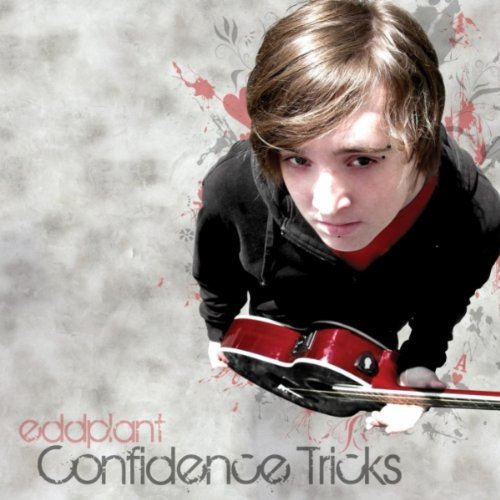
Edd Plant's Confidence Tricks skillfully shows how an image can be removed from the background and the backdrop can be manipulated. Having rendered clouds, the producer has introduced some interesting flourishes in red and black which connote playing cards and therefore back up the album's title. Card names such as the Ace of Hearts also feature which furthers this. The choice of props and clothing is also in keeping. The font, however, is quite common and therefore doesn't look as great as it could. I may take inspiration from this cover, but the font will be considered deeply and I will ensure to not use a famous, common one.

This album is particularly good because it showcases an extremely good set of editing skills. The photograph has been manipulated such that it now resembles a cartoon wth only two tones (for half of he image). The, then, introduction of a red pop art style gradient, really makes the art work pop out which would be the producer's intention. Logo wise, the incorporation of both names as one looks very nice and will clearly be memorable. The back cover continues the pop art style which I think looks really nice and achieves a great look while not overly difficult to reproduce. Again, the font is san serif and, in this case, entirely capitalised which is bold and iconic of the punky genre. The convention holds for more than punk, however, evidenced by the previous two album arts. The disc, which seems to be the same for most, merely continues the theme in terms of colour and logos or is fairly bare and quite minimalistic, such as the Jake Bugg disc.


Erase This by Alan Lastufka and Luke Conard is one of my favourite album covers. The abstract nature of the record really shines through with the paper design and title orientation. I am a real fan of the model being removed from their original background such as this and Confidence Tricks; I just need to be aware that making the image then look really nice will need some working. I also like the raw style overlay that has been used to merge the model with her background which is something I may attempt to use.

Shooting Plan for First Video Shoot

The first scenes I plan to film are few, but one of which quite adventurous which requires a small amount of forward planning. The first requires the dressing of a bedroom set to film a long take flashback in a mirror, though the second involves me artificially making a car look like it's moving while it is, in actuality, stationary and creating the special effect of the camera moving through the cars window. Most of the work on this scene, however, will be done in post so it should not complicate filming so much. Below is my shot list and below that a plan of Shot 34 which is the most difficult:


Shot 34

Equipment needed:
  • Camera Crane
  • Camera Dolly
  • Tripod
  • Greenscreen
The shot involves a slow zoom in to the window of a car while it is apparently moving. The camera will show the effect of dissolving through the passenger door window and showing the argument from within. This will be added in post production via motion tracking in Adobe After Effects. To achieve the slow zoom and eventual ending of the camera being inside the car, I will be mounting my camera crane on my camera dolly so that I can track towards the car on the dolly and the extended arm will enter the car. This must be extremely smooth as, even though I am using motion tracking, the smoother the shot the more professional it shall eventually seem. Before tracking, some of the area around the car may be visible which I must either mask out or ensure they are covered by the green screen. 


Marketing and Distribution

In a hypothetical sense, if this project was to be produced by anyone other than a student in school, certain areas would need to be funded. I was able to secure locations and equipment through both the fact that I am a student and my own involvement in building and designing etc.

The night club that agreed to allow me to film, for instance, is a business. If the project was being produced for a profit, therefore, the hire of the room would be factored in to the budget and they would most likely charge whoever was producing the Music Video. I also used the resources to my disposal such as the actors car and my own home rearranged to suit the scene. A much more desirable affect could be achieved by designing a set from scratch and using a studio, for example. This would require funding for hire and materials to do so which must be funded.

In terms of equipment, both the camera crane and dolly were funded by resources I could acquire for free and individual budgets devised by my colleague and I. The best option would have been a professional jib, but again, funding factors in.

The funding for these purposes would most likely come from both the Production company producing the project and the artist who the project is for. Where funding from these two bodies is scarce, there is the option to apply for funding from public artist funding organisations or private charities. Organisations such as the Princes trust are interested in projects such as this as they promote both the producer and artists. They, also, offer mentors who are knowledgeable in the goal the fundee is attempting to help. This, however, is difficult and can not be done by many. Larger artists set to reap large profits, for instance, would not be entertained as they should have the capital to create the video to begin with. My own project, as it features an unsigned artist would be eligible for funding as they do not, necessary, have much backing.

The History of Music Videos

The term Music Video can no more easily be wholly defined that the term Film. In many ways, Music Videos are all films; a combination of Visuals and Audio to entertain or evoke some form of emotion from the audience. The earliest dated 'relative' to the music video would be The Little Lost Child by Edward B. Marks and Joe Stern who commissioned a visual track to be created which was timed to synchronise with the song itself. This was known as the illustrated song and, from there, the genre ballooned.

The late 1920s brought with it the Sound Film (Synchronised Film to Music) which became an incredibly popular method of promoting an artist's song or album. Pinpointing the advent of the modern Music Video is tricky and impossible to be entirely precise, but the narrative style Video did not come into full fruition until the late 1970s and early 1980s. Prior to this, videos were predominantly performance show cases such as the plethora of Beatles hits which featured each member playing their respective instruments for the duration of the song. Post 80, however, Videos such as Michael Jackson's Thriller and Bad were released; the former including a defining moment in film history showing one of the first CG Werewolf transformations and the latter having been directed by the world renowned Martin Scorsese. This shows the integration Music Videos have with the Film industry and how much they have now progressed, from small accompanying stills to full blown epics to the extent that the most expensive Music Video to date cost $10.5 Million after inflation (Michael and Janet Jackson's Scream); seen as some films cost a miniscule fraction of this, the influence and importance of Music Videos are evident.

Song Change

Contrary to my previous posts, I have decided to slightly alter my plans in relation to the song choice. Originally, I had planned to use the song Tin Pan Alley by The Gaslight Anthem, though in retrospect I don't feel the song suits. Firstly, I am fan of the song and not particularly the official recording. To therefore use the song, I would have to record my own version, potentially wasting time on a mediocre recording. Secondly, I feel that the lyrics and story-line of the song stray from the idea I have confirmed for the visuals. 

To remedy this, I began to browse Unsigned.com to find a good choice of song which not only would be more suitable, but would allow me to use it without having to record my own version along with less restrictions on copyrights from the label. Fairly quickly, I came across an artist from Canada called Daniel Lewandowski who's acoustic song So Far (Now titled All I Want) immediately felt like the perfect choice. On further research, I found that he released a Studio version which I liked equally. Soon after this I was able to contact him to which he replied graciously giving his blessing to use the song. In addition, he has offered to create an improved mix of the song to my feedback to merge the acoustic and studio versions, in keeping with my original, acoustic premise. 


Moodboard

To express a few ideas for the Video and to convey some direction, I created a small Moodboard that prefaces my next post which shall be a draft storyboard of ideas. This Moodboard shows much more visually the outfit and choice of mise-en-scene than storyboard as they are obviously limited by the drawings. I have, however, ensured to include sufficient detail in shot descriptions.


Audience Survey Results

As a form of research for my Music Video, I decided to devise an Audience Survey that would enlighten me as to what my Target Audience preferred in a Music Video. This proved very useful as it has resulted in my contemplating whether a multi-strand narrative would be an interesting addition to my plan and, if I can devise a good enough narrative and storyboard, something I will most probably produce. The survey is to test my chosen plot which I provided the participants with and is situated below before the Survey files:

In a nutshell, I plan for the Music Video to begin with the ending of a party where difficulties have caused a fall out between one of the performers and their partner. After the scene is set that the party is over and all bar the two performers have gone home, one begins to perform the song and the other joins in. To reveal the falling out, there are flashes back to events throughout the night and other days where cracks are forming. By the end of the song; however, it turns out the partner has been listening from the exit and has returned.
Audience Survey
Compiled Survey Results
The data that can be found in the latter is very difficult to understand out of context, so below is a breakdown of each question and the responses I received. I have decided that my target audience will be predominantly Males between the ages 16 and 25 so these are the results I value most, though the others are good feedback for a general response.

Would you consider yourself a fan of acoustic music?

35% No      65% Yes
The majority of the participants that I canvassed expressed a positive opinion towards acoustic music. This is encouraging as a standalone question, though it's purpose was really to then determine the significance of their later answers. The majority of people in my target age demographic also enjoy acoustic music.


Do you enjoy watching Music Videos?

100% Yes
Again, though it reveals that I have chosen the correct brief for my target audience, this question is to determine the level of significance of further answers. 100% of my participants enjoy Music Videos, so the brief is obviously a good choice for all, not just my demographic. This means that I can value all other answers as they will be from people with experience and, more importantly, an interest in watching Music Videos. 

Is it important to see the artist and have them involved in the video?

30% No      70% Yes
70% of my participants felt the artist should feature in the music Video, a view I agree with which was a good result to obtain as I can follow my own beliefs while still catering to a large audience. 80% of my target audience, also, believe the artist should be involved so that solidifies my decision that they will be involved in both narrative and performance.


Do you feel the narrative of a Music Video is more important than the showcasing of performance?


40% Performance 40% Equal
20% Narrative
A number of my younger participants felt the performance side of a music video was more important, though as I am aiming the video at a slightly older audience, I feel their views are more representative of my audiences. I am also making an executive decision, despite there not being an overwhelming majority wanting it, to focus on narrative equally if not more than performance as I feel it will allow me to produce a Music Video more representative of my skills in film making and storytelling. 

What is your favourite Music Video?

It's difficult to represent open questions such as this in results, though I made a note of all responses - found below - and chose to watch all of the videos to gain inspiration, which I will do again when I come to draw my storyboard and shotlist; drawing from the successes of others. Two of the responses I actually chose to analyse for this blog which can be found in earlier posts.

  • Bittersweet Symphony by The Verve
  • Radioactive by Imagine Dragons
  • All the Small Things by Blink 182
  • This Too Shall Pass by Ok Go
  • Hurt by Johnny Cash
  • Teenage Anarchist by Against Me!
  • Buddy Holly by Weezer
  • Pillow Talk by Wild Child
  • Parklife by Blur
  • Wicked Game by Chris Isaak
  • Telephone by Lady Gaga
  • Let Her Go by Passenger
  • Little Talks by Of Monsters and Men
  • Only Love by Ben Howard
  • Billie Jean by Michael Jackson


Would you rather the Music Video involved Humour or was more Poignant?

45% Humour     55% Poignant
This was a fairly definitive question; in the conception of my narrative as their are two basic themes of all texts, the Comedy and the Tragedy. I know that my main plot would work with either, so I decided to obtain which would be most appealing to others. 55% agreed that it should be poignant, though this is only just above half, so the views were fairly equal. Due to this, I may add aspects of humour to please all, though the video will focus mainly on the telling of the story and conveying of emotions.

I plan to use black and White for flashback scenes; would this appeal to you or would you rather they were graded (coloured) differently to express this?


30% Graded   70% B&W

This question is specific to a certain aspect of the video to which I did not know how to create the effect. The majority of the people asked thought Black and White would be a good effect, though a small minority liked the idea of grading the video differently. Of my specific audience, the weightings were fairly similar in opinions so I may use Desaturation and grading to appease both, but also produce an effect I am happy with.


Are you a fan of my idea? (see introduction post)


A resounding majority were fans of my initial idea, which is beginning to flourish as a more fleshed out narrative, so I am happy that I am going the right direction with production. Those that did not like the idea only expressed their scepticism as to keeping interest, which I can hopefully do. One, also, suggested that the story may not be weighty enough for a full video, which began my contemplation of a multi-strand narrative covering a number of the party guests - focusing on the musician and his partner. 

The final question wasn't answered by many as it was very open and optional, though I did receive some good suggestions - including the multi-strand narrative. One participant felt venue was very important, a view I share, so in location hunting I must be sure I have the correct place. 

Textual Analysis - Broken by Jake Bugg


Broken by Jake Bugg is a very cleverly produced Music Video as, at first glance, it seems like a performance video merely set in a realistic setting. The video, however, not only has one narrative, but follows a multi-narrative structure - subtlely following a number of groups, inferring a storyline and offering a glimpse into their realistic lives. The lack of detail and ambiguous nature is revealing of the complexities of people and, ultimately, their relationships. To convey a full story arc, reminiscent of Todorov's description, would be very unrealistic and, I believe, that is the Producer's justification. The following is a step by step analysis of shots and audio:


Textual Analysis - Pillow Talk by Wild Child


My second textual analysis was of the Music Video for Pillow Talk by Wild Child. This is a very good example to analyse, because it is very saturated with imagery, despite the lack of characters or definitive settings. The use of lighting is stellar and is of a standard I would love to be able to replicate in my own video. The narrative depicts another love story ending, which is fairly thematic across the acoustic genre, which is the direction I believe my narrative will take. I've produced a flash slideshow again to show my annotations, shot for shot and to represent the meaning I defer from the choices the Producer made:

Textual Analysis - Let Her Go by Passenger

The above video is the official Music Video for Let Her Go by Passenger, which is a song of the acoustic genre, which is the area I wish to make my video for. The nice twist in this video, however, is the fact that the producer has used real life footage to infer a narrative. Shots of Passenger with the female vocalist are interspersed to imply that she is the subject of the song. This is a fresh take on the narrative of a music video, as it includes performance seamlessly and the story has increased validity due to the documentary style composition. Below is a step by step annotation of the whole music video - clicking the arrows to the side of the screenshots will progress and move backwards through the notes:


Introduction

This blog will be a working record of my progress in producing a final A2 production. My chosen brief is the one below:

A promotion package for the release of an album, to include a music promo video, together with two of the following three options:
 • a website homepage for the band;
• a digipak for the album’s release;
• a magazine advertisement for the digipak.

I will be creating both the band's Website Homepage and the digipak artwork as my ancillary tasks.

Due to copyright issues, I plan to arrange a cover of a song called Tin Pan Alley, originally by The Gaslight Anthem. I chose not to contact The Gaslight Anthem's record label or the rightful owners of the song to gain permission for the original recording as I want the ancillary tasks to be accurate to the recording used and produce the entire package relevant to a new artist, not The Gaslight Anthem themselves. The cover will be similar to the acoustic version below performed by the lead singer of The Gaslight Anthem, Brian Fallon:


My initial idea, which will be developed is for the Music Video to begin with the ending of a party where difficulties have caused a fall out between one of the performers and their partner. After the scene is set that the party is over and all bar the two performers have gone home, one begins to perform the song and the other joins in. To reveal the falling out, there are flashes back to events throughout the night and other days where cracks are forming. By the end of the song; however, it turns out the partner has been listening from the exit and has returned.