Venue Enquiry

Music Video Final Storyboard
After I had completed my draft storyboard of ideas for the production, I knew they would need refining into a comprehensive storyboard of shots complete with timings and detailed descriptions. I have compiled the final shots into a presentation which can be found below.
I wanted to wait until I had filmed a lot of my footage, because - as you can see - I knew I would be adding a number of revisions and retimings to make the shots fit. Due to the crossings out etc. the original idea are still apparent, however, so I feel this is a cohesive representation of my planning process.
Shooting Plan for First Video Shoot
The first scenes I plan to film are few, but one of which quite adventurous which requires a small amount of forward planning. The first requires the dressing of a bedroom set to film a long take flashback in a mirror, though the second involves me artificially making a car look like it's moving while it is, in actuality, stationary and creating the special effect of the camera moving through the cars window. Most of the work on this scene, however, will be done in post so it should not complicate filming so much. Below is my shot list and below that a plan of Shot 34 which is the most difficult:


Shot 34
Equipment needed:
- Camera Crane
- Camera Dolly
- Tripod
- Greenscreen
The shot involves a slow zoom in to the window of a car while it is apparently moving. The camera will show the effect of dissolving through the passenger door window and showing the argument from within. This will be added in post production via motion tracking in Adobe After Effects. To achieve the slow zoom and eventual ending of the camera being inside the car, I will be mounting my camera crane on my camera dolly so that I can track towards the car on the dolly and the extended arm will enter the car. This must be extremely smooth as, even though I am using motion tracking, the smoother the shot the more professional it shall eventually seem. Before tracking, some of the area around the car may be visible which I must either mask out or ensure they are covered by the green screen.
Theory Application: Andrew Goodwin
Andrew Goodwin
Andrew Goodwin is a theorist that focuses on Music Videos, so it is very applicable to this project. He states that there are five key aspects to a successful music Video that an audience member looks out for and is ultimately satisfied by. These are as follows:
- Thought Beats
- Narrative & Performance
- Star Image
- Relation of Visuals to the Song
- Technical Aspects of the Music Video
The least obvious of these five is the Thought Beats - it relates to seeing the sound in your head and, ultimately, creating links between the style and sound of a song with the artist who it is created for. Music Videos must therefore use appropriate imagery to relate with the audience and enforce memorability.
The narrative and performance is important as an audience member does not immediately understand an entire narrative from just the song involved. With the addition of the Music Video's narrative, the whole story is conveyed and the audience no longer need to imagine the story. In this aspect, Goodwin states how important the lip sync is to a Music Video and how it ties up the authenticity of a story's relation to the singer/actor.
 The star image relates to the individual (often the singer) that the audience is persuaded to support and connect to. This not only applies to Music Videos, but Band management where even in a larger band, a star is formed that the audience eventually likes more than any other, such as Take That with Robbie Williams and after his leave, Gary Barlow or The Jacksons with Michael.
I believe, most importantly, are the visuals being parallel to the audio - unless the intent is to be purposefully contrapuntal - and that is one of the aspects detailed by Goodwin. There are three forms of this:
- Illustration: Visuals that are entirely parallel, sometimes fully representing the lyrics exactly with very little difference in story.
- Amplification: Desired meanings are conveyed, used more to represent morals.
- Disjuncture: As aforementioned, visuals that are completely contrapuntal to the audio and often abstract.
 The technical aspects are very important; they involve the skills required and knowledge needed for a successful text. The four main areas are Camera Work, Editing, Mise-En-Scene and Sound. In terms of camera work, a successful piece must portray an array of shot speed, movement and design to interest the audience. Editing in Music Videos refers mostly to cutting to the beat of a song and creating parallel pace. Mise-en-scene is important as it refers to everything in the scene and manipulating this can produce a range of desired effects, enabling messages to be conveyed well. Sound is, oddly, not as relevant as the others other than a relation between the visuals and song. It sometimes applies with foley which should be of a high enough quality to fit with the rest of the project.
Theory Application: Uses and Gratifications
Uses and Gratification Theory
The Uses and Gratifications theory (U&G) is widely renowned as the turnaround theory; it doesn't challenge the claims of other theories, it focuses on an area of the media that no other had done before. Where most media theories focus on 'media effects' or what media does to people, the U&G theory outlines what people do with media. The gratifications side of the theory also covers the older side of theories as gratification involves the positive effects of media on people and therefore covers earlier areas.

Originally conceptualised in 1940, the U&G theory was not popularised until 1974 when Blumler and Katz wrote about the individual needs of audience socially and psychologically. Despite this, however, the lesser known theorist, Denis McQuail detailed the four categories all audiences fall within when they consume media and what they, therefore, do with this media, which is the most famous form of the U&G theory. Below are the four categories and their criteria:
Information
The Uses and Gratifications theory (U&G) is widely renowned as the turnaround theory; it doesn't challenge the claims of other theories, it focuses on an area of the media that no other had done before. Where most media theories focus on 'media effects' or what media does to people, the U&G theory outlines what people do with media. The gratifications side of the theory also covers the older side of theories as gratification involves the positive effects of media on people and therefore covers earlier areas.

Originally conceptualised in 1940, the U&G theory was not popularised until 1974 when Blumler and Katz wrote about the individual needs of audience socially and psychologically. Despite this, however, the lesser known theorist, Denis McQuail detailed the four categories all audiences fall within when they consume media and what they, therefore, do with this media, which is the most famous form of the U&G theory. Below are the four categories and their criteria:
Information
- News on events globally and locally
- Opinions or popular advice
- Teaching skills or knowledge
- Finding similar views to their own
- Evaluating own views
- Identifying whether another's views are like their own
- Social news for empathy
- Identifying with others (extension of identifying one's self)
- Finding conversation subjects
- Substitute for real-life similar views
- Allows for relating with family and friends.
- Escapism and immersing one's self
- Relaxation
- Confirmation of cultural views (similar to identity, but giving enjoyment due to this)
- Time wasting
- Evoke sexual arousal or emotion
The Uses and Gratifications must be taken into consideration when creating Media texts as the producer must have a plan for their audiences uses. The most effective of these is to create a text which attains a majority of audience members in the integration and social interaction category as these criteria involved 'integration' with others in 'society'. The more people an audience member interacts with concerning the test, therefore, the more views and fans a video will receive. This can be done by involvement of common events which are likely to evoke discussion or a great level of narrative which will gain an audience that wants to share the text with others. A great example of this is the way TV Show producers use cliff hangers from episode to episode; along with social media, audience members choose to discuss the excitement and anticipation with some who are yet to watch, but likely to do so.
Camera Difficulty

Not only for this project, but to have my own high quality, professional device for filming future projects and taking still images, I decided to upgrade my camera. I previously had the Canon EOS 1100D which was used for my AS Level Media film, but does not provide the same film quality as the more advanced models. As a replacement, I decided to purchase the Canon EOS 650D, which is the cheapest model which offers 1080p video recording, but still has a similar ISO range.
Unfortunately, however, the company I 'purchased' the camera from was illegitimate and there were hidden costs which I was not notified of before purchasing. Cancelling this order, I then had to work extremely hard to retrieve my money as a refund, resorting finally to claiming through PayPal due to the difficulty the company posed.
Once the money came through from PayPal, I decided to find a reputable, high street company to purchase the camera from which posed another problem. Most stockists do not offer the 650D, though they do offer other models. I, therefore, began to look at the 60D which is a fair few models up from the 650D, let alone the 1100D and provides a much higher quality of video and stills. It also supports a greater range of features which are well worth the extra price. I, therefore, knowing should I order this I would never need another camera, opted for the 60D.
Now that I have the camera, I can begin filming which has kept me behind slightly.
Equipment Choice


Alongside this, I am using the tripod I used for my AS Production which is very lightweight, but sturdy so can be used for stable shots, but is portable enough for stabilised, handy cam shots.
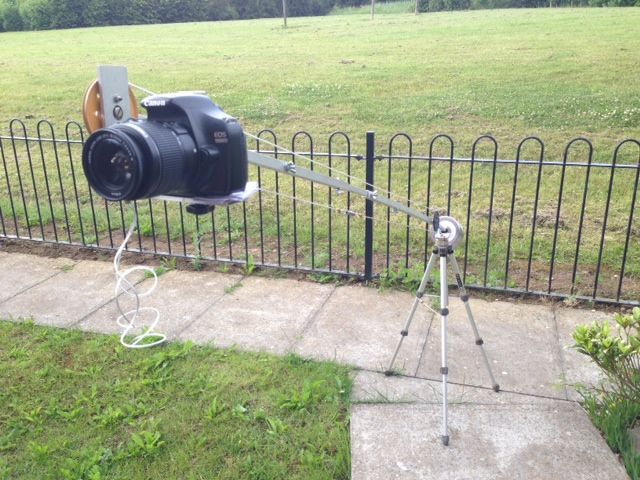 On top of these two, essential pieces of equipment, there are a number of specialist implements I plan to use which will embellish and accentuate my project perfectly, adding that desired professional feel. These include the Camera Crane I have already featured a post on and a soft box of my own design and build. Below are a few pictures of the process and explanation of it's components.
Soft Box
The soft box consists of:
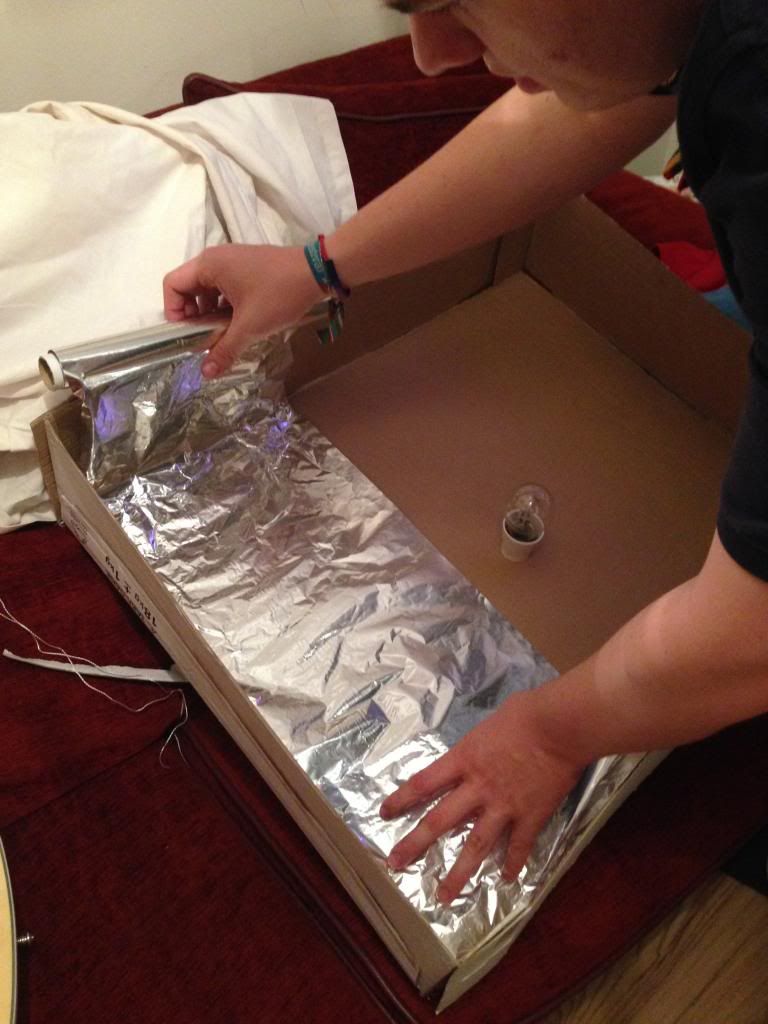

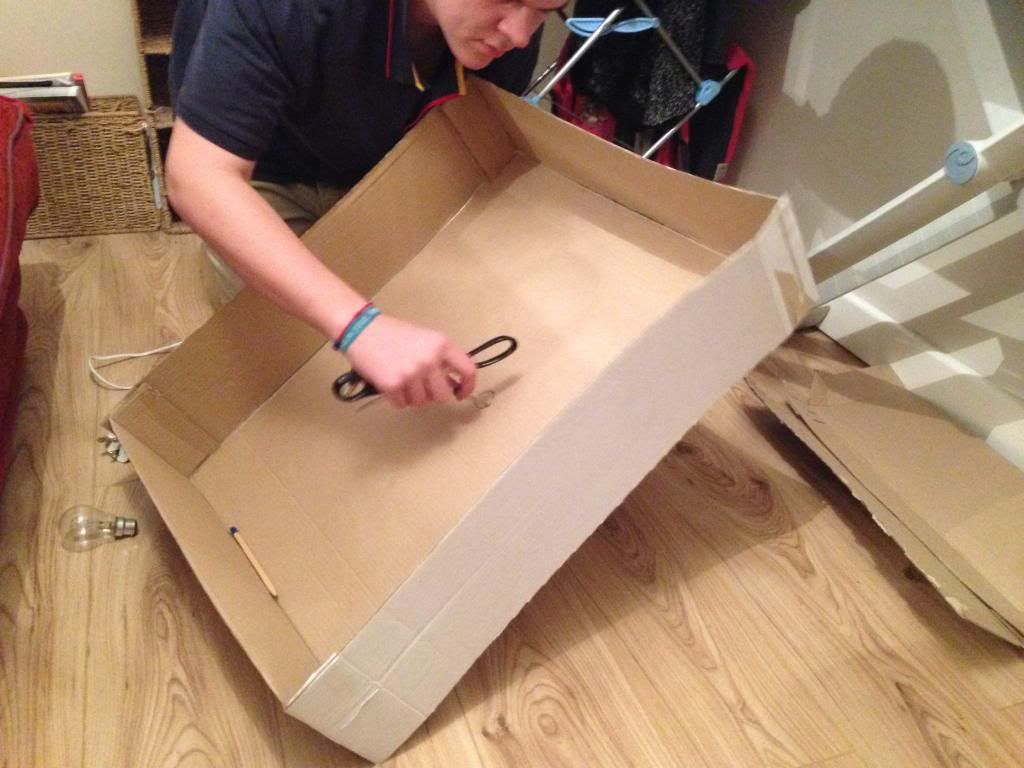
Forming a small, lidless box out of larger sheets of cardboard, I began the softbox. I then measured the circumference of the clamp light so that it could be mounted in the box' back.
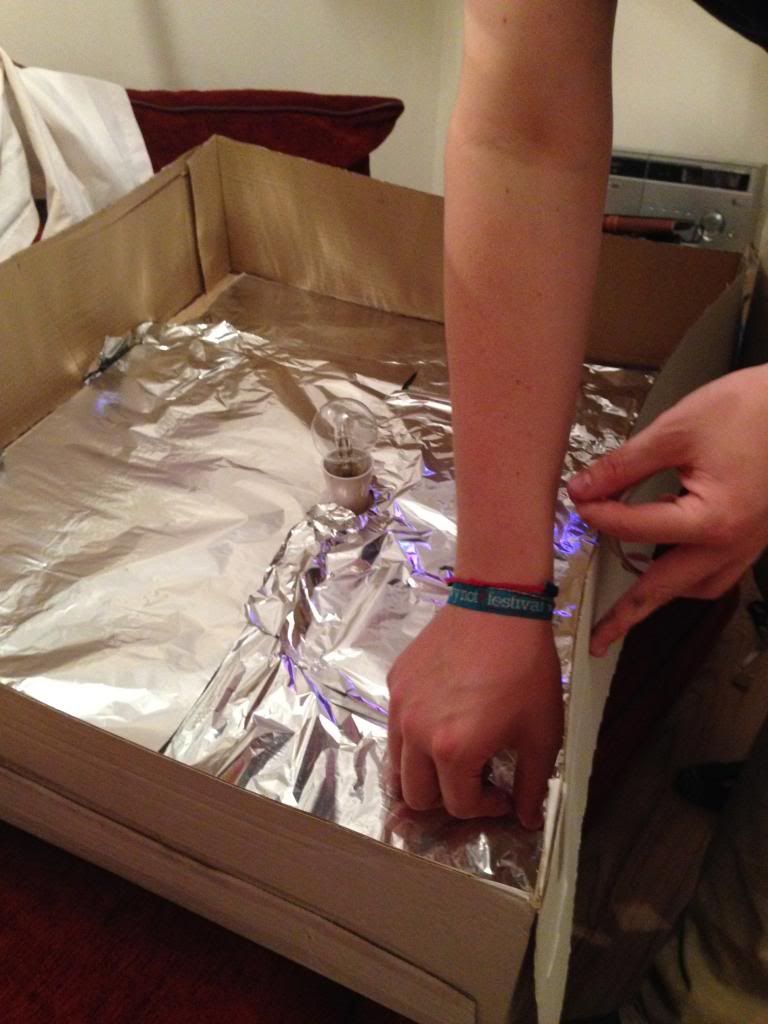
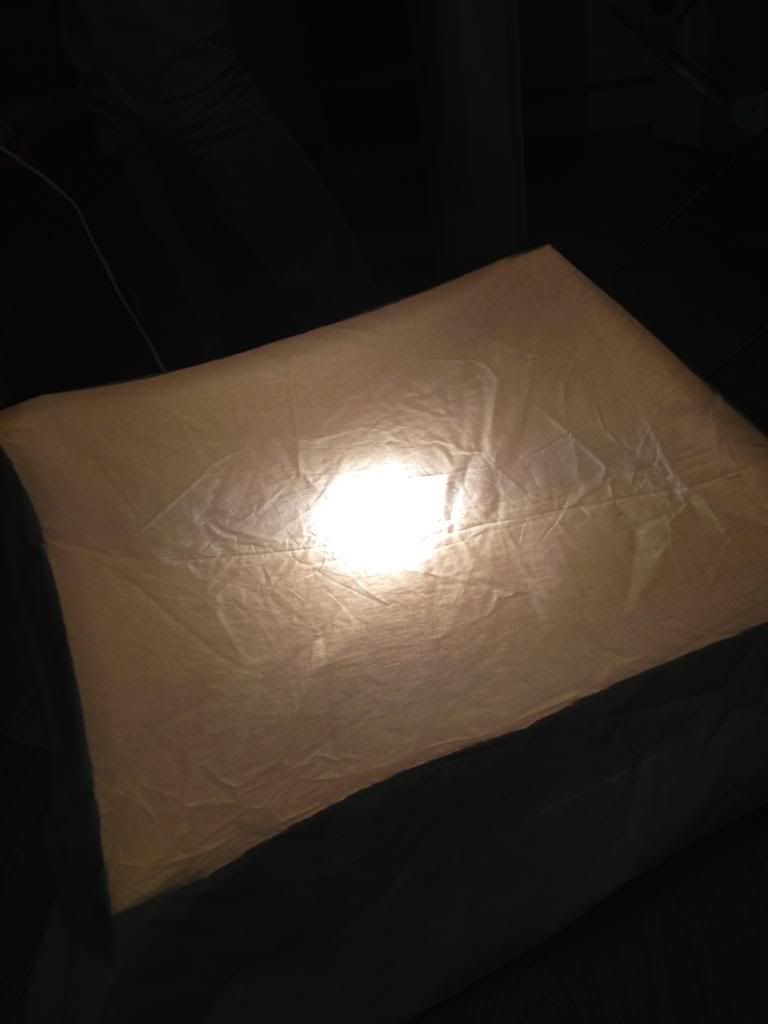 Firstly, I placed the white sheet over the cardboard at this time, but the light did not reflect enough around the box and was too central (left). To remedy this, I decided to line the box with tinfoil which works by bouncing the light around the box and then through the dampening sheet.
With this lining, the light spreads much better and it can even be used without the sheet as a powerful 'flood' light should my setting be dark enough for it. This is a very cheap, but effective way of achieving a well lit scene and it should help a lot for production. As the light bulb is a tungsten, indoor bulb I may have to alter the white balance on my camera for the scenes I involve this in - especially if it will be the main source of light for the shots.
Subscribe to:
Posts (Atom)